Showing posts with label tour of flanders. Show all posts

Wednesday, 5 September 2012

Ronde van Vlaanderen: How to Ride Cobbles

This will be the final post in my trilogy of Ronde van Vlaanderen novels, featuring suspicious characters and shady exchanges of all varieties: be it pecuniary, alimentary or linguistic-ary. Sometimes even all three together. Most of the time, in fact.

Last week I made my familiar migration over the hills (I have since found out it's actually about 40km each way, taking about an hour and a half) to the town of Oudenaarde to complete the final leg of the coloured triumvirate that I began a few weeks ago. All that remained for me to discover was the blue route, which covers 80km and in particular some of the longer and rougher sections of pavé, or cobblestones.

This loop heads North out of town, generally in the direction of Gent, before veering East to Zottegem, and back around to the South through a series of twists and turns until it arrives slack-jawed and trembling once again on the doorstep of Oudenaarde. It is pretty flat, at least on paper, but as these things always feel like in reality, it's up and down most of the time. Not only that, but there seemed to be a fairly brisk headwind at all times, just to make sure it wasn't any easier than its hillier brothers, the orange and green routes.

The first section of cobbles goes past one of the first of the Molen (windmills) that I have seen here, and I can tell you they're as quaint in real life as are the stereotypically bucolic countrysides you see them in, on TV documentaries and in National Geographic photospreads with the be-clogged people of Holland and Flanders. I was concurrently trying to make it through the constant bumping and clanging of this stretch of cobbles as I took the photo, so my hands were anything but still. Somehow it seemed to come out alright!


I'd heard it said, probably by Phil Liggett or some other mollusk of the cycling world, that the best way to ride pavé is to chuck it into a big gear and pedal at a moderate yet comfortable cadence, maintaining a decent clip. This is definitely good advice, as the bigger gear keeps tension on the chain which stops it from slapping the frame so much, and potentially falling off. But there's a limit to how much comfort one can expect to enjoy across terrain such as this. Some of these sections were two to three kilometres long, so even cranking along it's still a few minutes as least. Plenty of time to rattle loose those fillings, expose your root canals have you grinding what's left of your teeth down into blackened stumps. And that's not to mention the other parts of your body that will suffer: hands, eyeballs, internal organs. In the interest of keeping your bum comfy, it's necessary to stand slightly out of the saddle, taking the weight with your arms and thighs. Combine the large gear, trying to ride fast so as to even out the bumps, then standing up, and it adds up to be an absolute killer for your thighs. Interestingly however, of all things I found the itchy bites on my arms and hands were the most affected by riding cobbles. I suppose it's because they are quite firm when swollen (mine tend to get very large, I don't know if it's an allergy or what) so they shake around and feel like they're coming loose. If only they did!

You're in for some chop, riding the waves of cobbles
Steady as she goes, captain.

I was making pretty good progress through Doorn, but I could hear a car approaching from behind. It's a funny sensation, the more you ride on the road the better you get at judging the stealthy approach of vehicles. But riding on pavé turns all this upside down. You hear noises, plenty of them, but they're all coming from your bike. Bits of your bike that don't even move make noise. You hear cars approaching all the time, sometimes very convincingly, only to look back over your shoulder and find a deserted stretch of road between the cornfields behind you. Your bike is capable of making all kinds of new and interesting noises in such a setting, but almost every time you hear an unusual one that could be a vehicle, it's just your rear wheel messing with you. When you do actually witness a car drive over cobbles, you wonder how you could ever have thought that the noise from before was a car. They are so much louder, and you can feel the ground resonating beneath their wheels. That is, if you can feel anything at all. This time I was correct, and there was in fact a Police car on my tail. I was riding more or less in the centre of the road, trying to find the smoothest line over (although most of the time it was between) the ramshackle cobbles. I was worried my bike was going to disintegrate beneath me, such was the roughness of the ride, so I wasn't really in a mood for moving aside into the even more marginal state of roading on the right. Whether they were being patient or just not in a hurry I don't know, but they didn't catch up to me.


I was then able to enjoy a very pleasant hour or so until the next setion of pavé. You really appreciate how buttery-smooth a normal road surface is for the next 5 minutes or so after cobbles, it's like ice cream on a really hot day. The next step was Paddestraat, 2.4km long. At least the first section of it, that is.


Then just when I thought I'd made it through alive, I crossed a main road and was hit with this, an old Roman road. Cobbled too, of course.


So I don't know how long it was in total, but by the end of it I was worried my arms were going to give way beneath me. It's really hard to change gear when you're cobbling along as the bike, and therefore the chain, is jumping around all over the place. Your hands are also sort of floating somewhere around the handlebars, which isn't a very secure feeling either. You've basically got to pick your gear early and stick with it. I learned this fairly early on, and likewise how to put on a Belgian hard-man grimace. It's easy enough to peel off again when you're through the worst of it.

I stumbled upon what I think is probably the nicest looking goat I have ever seen while on this ride. I've never seen so many goats as in the backyards and hobby farms that are scattered all over these lands. I can only assume people tend to them for the milk and thus cheese products they can produce, because they certainly aren't kind to your front lawn. They'll eat anything - thorns, grass, steel wool - but they normally won't leave it looking pretty. Here is my new friend, who was obviously proud of his patch of pasture:


I think it helped not getting lost or going the wrong way at all on this particular occasion, as the 80km loop took me about three hours, roughly (but) as I had hoped. As I made my way back home to Enghien I stopped off at a Frituur for a drink and a snack. The owner was a slightly washed-out looking character, but very friendly and happy, enthusiastic even, to point out in detail all the different sizes and vessel materials that he had of Coke for sale. I spotted a chocolate milk for €0,80 and so, reminiscing the week I spent practically living off that stuff during the Kiwi Brevet in February, snapped it up along with a can of coke and a small Milky Way.

That was an unnecessary description of the Milky Way. An unusually principled stalwart of tradition, the Milky Way has always been small, curiously yet nobly remaining steadfast against the tide of ever-increasing chocolate bar size. I don't recall seeing them around much lately, perhaps they stamped out millions of them in the 80's and 90's then closed the factory, and those that remain as yet unconsumed are really historic artefacts of a bygone era. Even if that were the case this one was still particularly delicious, and with no discernible discoloration despite potentially being as old as me.

I took a seat and attempted to read the newspaper I found in front of me. I was able to make out a bit of it, mainly because I was familiar with the story already. It was just after the big drama involving Lance Armstrong had begun to escalate:


As I was seated doing my best impression of comprehension, the owner came over to me with several pastries on a napkin. He was clear to point that they were yesterday's, but that I could have them if I wanted. I had one pain au chocolat, but after the Coke, chocolate milk and Milky Way, didn't think I could handle any more. He put them in a bag for me and bid me farewell. He was a cool guy, and whether it was because he didn't know too much English or if he was just patient, he let me try out my somewhat increasing ability to butcher the Dutch language with him. I made a point to remember where I was, so that I could stop by another time.

Each time I pass through Geraardsbergen I take special pains to go up the Muur-Kappelmuur. Partly because it's on the way and avoids busy roads up the hill, but mainly because it's just such a cool place and you can't help but feel like a legend of cycling history when you crest the final rickety rise. This time I was climbing to a big crowd of spectators, lining the street on both sides cheering. Well, maybe they were just talking, but either way they were buzzing in anticipation for what I soon found coming up where I had just been:


It was the Stadsprijs Geraardsbergen voor dames, I assume, a kermis race that (at least for the men) has been going on for nearly 100 years in this town. I saw the Australian girls that I nearly got to talk to the other day, still slogging it out in the race on the last lap when it goes up over the Muur. I watched as they all made they way past, most looking pretty whacked by this stage, then continued back home for some pasta and a salad.

The previous week when I was climbing the Muur I saw a sign advertising the Stadsprijs race on Wednesday 29th of September. I could see that it was for professionals, but when I went to the website I saw that there were wildcard entries available for riders without a contract. I spent a few days wondering about this, and with some encouragement from Darryn I was going to try and enter. When it got closer to the time and I still hadn't entered I thought it was probably not going to happen. But after being there for the women's race it made me really want to just go in it, regardless of the fact that I'd be racing professionals and the moment they put on the gas I would be spat out the ass, so to speak (I realise an ass is actually an animal). So the next morning I took it upon myself to phone the organisers and see about getting myself amongst it. I'll let you know in another post how it all panned out.


Wednesday, 29 August 2012

Ronde van Vlaanderen: Part II

After the success of my last outing in the Flemish Ardennes, dragging myself through the 160 or so kilometers of rolling country lanes in just under 8 hours, I thought it worthwhile to have another crack at one of the coloured routes they have so conveniently laid out in the area. This time I was going to follow the Oranjeroute, or Orange Route. It has been designed as the "hilly" of the three coloured routes, and as you can see it takes in most of the famous climbs of the Ronde.

The white blocks denote sections of pavé
As I was leaving Oudenaarde to start following the signs, I found myself catching up with a bunch of Australian women, riding in national kit with a guy leading the way. I caught up with them, but unfortunately there was an even number of them, so noone who I could easily get the attention of without interrupting their conversation. What I should really have done is sidled up to them and given them a big "sup ladieeees!" as is the usual approach in New Zealand. But I would've needed to be in my turbo Subaru Legacy with blow-off valve for it to really do justice though. Anyway while I was wondering about the best way to get their attention without crashing into the lot of them, I saw the sign pointing me in a different direction from where they were headed. I followed the arrows, this time vowing to pay more attention and not get lost like last time, and hoping to do the ride in 6 hours.

After turning off a main road, I found myself on a nice quiet flat stretch heading seemingly away from the hills. The last sign I'd seen pointed straight ahead, but then there'd been an intersection with two paths coming off it so I had taken the one straight ahead. Maybe this was the wrong way? I continued for a while, then decided to turn back as I was definitely not heading towards the Kluisberg.

I passed a man stopped, inspecting his bike on the path. I stopped initially to ask him for directions but when I saw he was looking at his derailleur I offered to help. When you hardly know anything in a language the most basic sentences can be used for almost anything. I asked him is everything good? And he proceeded to tell me a whole lot of information about his bike, none of which I was able to decipher. I then had to tell him I didn't speak any Dutch, so he laughed and did his best in English. He was friendly and had a sense of humour, I liked the look of this guy straight away. It turned out his bike was fine, and he was just inspecting/admiring the repair job he had done on his own frame by welding a brace over where the chainstay had cracked. He didn't know about the Oranjeroute, but was keen to tell me about all the bergen that I should ride - Kluisberg, Koppenberg etc. I told him that was the plan, and he proceeded to wave down a passing postal service worker to ask him if he knew where I should go. He didn't know either, and before hopping back into his van he smiled and said he was also a big fan of the Ronde. As I backtracked with my new friend Luc, he told me about how he had recently retired from a career teaching design, and I told him about my plans. He was excited for me, and when we parted company wished me all the best and that he hoped see me on TV at some stage.

I had actually been going the right way as it turned out, but there had been a corner further up which wasn't marked. So after re-backtracking to this point I turned there and found myself once again in the orange. I remembered that the map shows quite a long flat section heading West before you get to the first of the climbs, so I needn't have worried about seeming to head in the wrong direction. I had a pocked full of muesli bars, a bottle with electrolyte solution and about €7 to burn, so I was all set to be able to last the day.

I decided to try out one of the muesli bars, and found it was a coconut flavoured one (they are all packaged in the same blank white wrapping for surprise's sake). It was absolutely delicious! I couldn't believe my luck, having just grabbed it off the shelf in a supermarket. I got halfway through it then going over a bump on the cycle lane it slipped out of the wrapping and disappeared behind me. I couldn't carry on with the knowledge I was only halfway through it, so I stopped and turned around. Only to find this wee chap eyeing me up suspiciously.


I looked all over the path, up and down over a section of about 10-20 metres. My delicious muesli bar remnant had to be there! A puffed rice and coconut base coated in rich sweet chocolate, delectable. I looked back at my little mate in the grass, and before my very eyes he poked his tongue out at me!


Was he toying with me? Smug little thing, I started to wonder about his motive for being there. Surely he couldn't have grabbed my precious snack travelling at about 30km/h and wolfed it down in the space of a second? And now expected even more? I wouldn't have thought it possible, until he had the scurrility to expose his tongue to me in such audacious fashion.

It was a fairly hot day, perhaps this was getting to me a bit. Sure enough after a few minutes of wandering about wondering, I found my treat lying happily nestled under a few strands of grass right on the edge of the cycle path. With a flourish I popped it in my mouth before the little brat could sink his teeth into it, and continued on my way.

Before long I made it to the base of the first hill, and it surprised me with its length. I kept expecting it to turn into pavé at any moment, but it remains sealed the whole way up. This is the Kluisberg, and I'm sure the scene of many crazed cheering fans during the actual race. Today it was, well, pleasantly devoid of activity.


The next section took me, funnily enough, out of Flanders and briefly into Wallonia, the French-speaking region of the country. The next few climbs are technically just going up the same ridge as the Kluisberg (here called Mont de l'Enclus) but from different sides and further East. I wouldn't complain though, as they are all nice leafy affairs, each with different characters. Most importantly they are rare hills in what is a fairly vast sea of corn fields and pasture which, coming from New Zealand and especially Wellington, you can't help but notice, and certainly never forget.


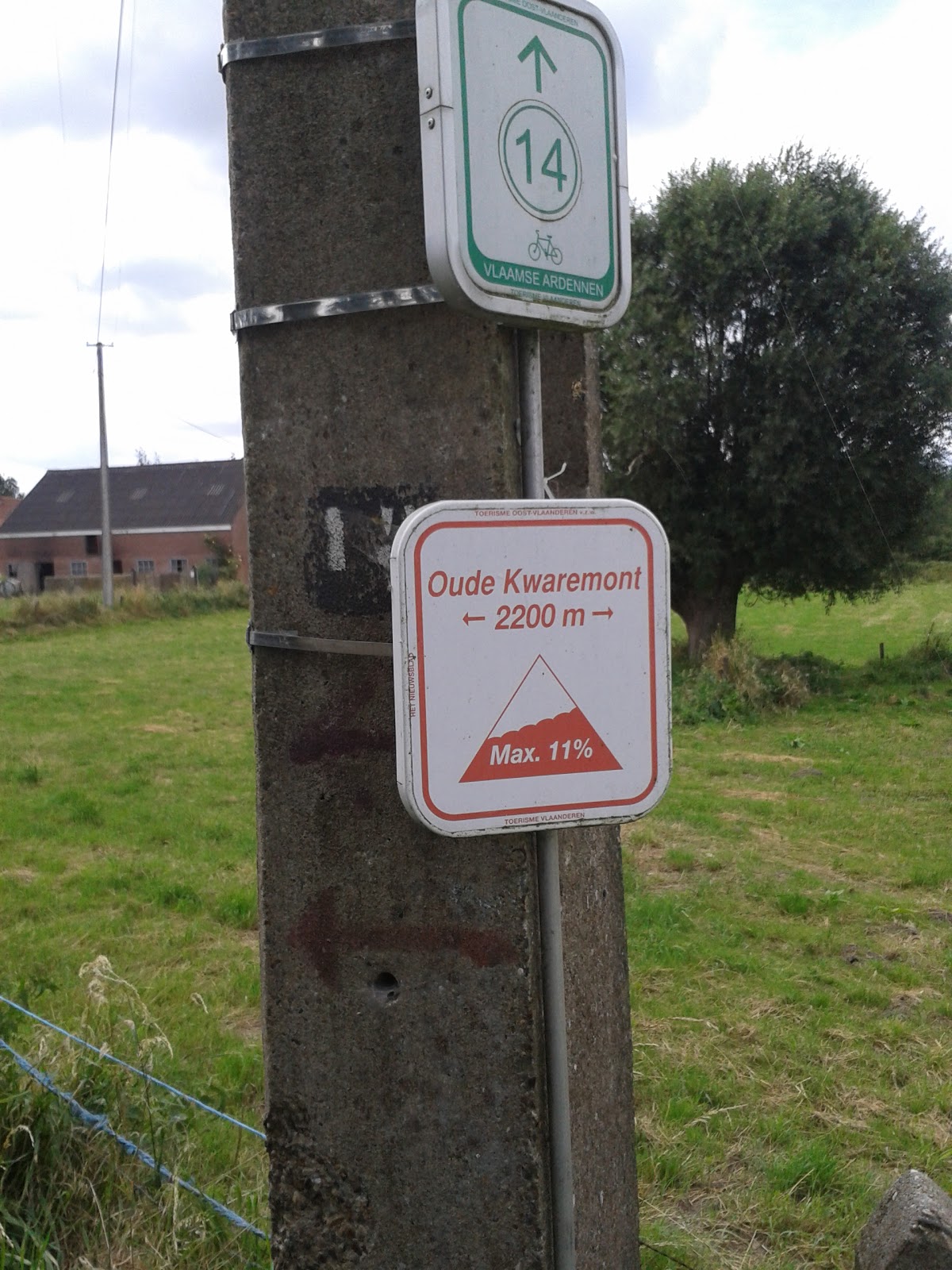
The Oude Kwaremont was a really nice one - a very steady 4.2% average gradient, maxing out at 11%. At over 2km in length it certainly starts to feel long enough, and is pretty rough in parts. I hadn't gone up too fast, so the bumps weren't so numbing, but they are always discomforting no matter what speed you attempt it.

People live on these streets, that's probably the thing I find most curious about these places. You can be riding up here in a pastoral haze, just thinking about Eddy Merckx and Roger de Vlaeminck stretching the pace, suffering, and imagining the crowded fans frothing at the mouth hoarse from passionate shouting, soaked from rain or beer (or probably both). Then the next minute you look around and see people opening the boot of their Renault, Peugeot or Citroën taking out their groceries, calling to their children to hurry up, pressing their remote to lock the car and walking up the path to their front door. This was especially the case on the Kruisberg, which is in the middle of the town Ronse. The pavé starts a bit further up, just after the white van.


It's hard not to try and find equivalents to everything back home, or at least make comparisons with what you see and experience. But in cases like this, it's hard to find a reference point. The history is just so different in this part of the world, and it seems humans are the same the world over, whereby we grow accustomed to our environment and stop taking note of what we have. Some of the roads around here were originally built by the Romans, so are a couple of thousand years old. Perhaps, if it were possible, biking through a forest of thousand-year-old Kauri in Northland would elicit a similar sensation. But the nonchalance with which people go about their daily lives here around these historical artefacts piques my interest almost as much as my desire to be a part of and share in its rich history. In the end though I suppose they have lives to live and this is where they're doing that. They would, I'm sure, have similar thoughts if our positions were reversed and they were visiting New Zealand.

The next berg was one of the most challenging, and certainly one of the steepest. It came at me suddenly, around a sharp bend at the end of a glorious flowing downhill. I've been borrowing a wheel from the local bike shop after I broke a spoke in my own one last week. I hadn't adjusted the gears properly, so inadvertently put myself in hard man mode, as the rear derailleur won't let me onto the 26t at the back, reaching instead lazily as far as the 23. I managed to ride it all seated, but this is also out of necessity - traction is very minimal at best on the pavé, and standing up just exacerbates this.


At the top I took the opportunity to avail myself of the facilities provided. Namely, a bench seat with a great view of a nuclear reactor and a jam-packed rubbish bin.

I think it's just one of those wannabe nuclear plants. They're a dime a dozen.
After a brief battle with a wasp for the remainder of another delicious muesli bar, I continued on my way through this much more enjoyable day's worth of riding. I had been looking forward to this next climb for the whole ride, as a lot has been said about it. It is the hill with the cobblestones from which the term kinder koppen has been coined. This translates as "children's heads", I assume because they are rounded and about the size of a child's head. This has in turn been abbreviated to koppen, and thus we have the de Koppenberg


Over the course of the last century this road had degraded so much so that riders complained and it was even removed from the Ronde briefly due to safety concerns. It has since had a lot of work done to it, and now if it weren't for the distinctive "koppen" shape of the pavé it wouldn't be especially remarkable. It was certainly challenging in its gradient, getting up to 22%, but due to the generally excellent condition it's actually not as arduous as it could be. On a fine, sunny day that is......

Token shameless self-promotion shot
I always find these mirrors a little confusing. I understand what they're there for, but the reality is that in order to get to the point where the angle is right to be able to see what's coming in the other direction, you've gone so far as to be practically in the intersection already. At the very least, if you haven't slowed down to a crawl by now, you're certainly not going to be able to stop in time should you meet something coming the other way and only see it when its reflected gaze meets your eye.

This leads me to another thing I've noticed so far in my time here. Roads, and in particular the system of physical markings on streets and the use of roadsign designations is very different from New Zealand. At first it's a bit of a shock - when you stop at an intersection, it's easy to go too far forward and not be able to see the traffic lights. They often only have one light per entrance to the intersection, so you have to keep your eyes peeled for it. In fact you have to keept your eyes peeled for everything, and I think that's probably the point. There tend to be few paint markings on the ground, but many more signs about the road with warnings of upcoming features and your responsibility thereby. Combined with generally rather narrow roads, and the excellent law based on your relative danger to other road users (a sliding scale whereby the more dangerous/larger vehicles bear the weight of responsibility in any events that involves others. For example a truck is responsible in conflict with a car regardless of fault, likewise a car is responsible for the safety of cyclists, and in turn pedestrians are at the top and even as a cyclist if one jumps out in front of you it's your job to ensure you don't have an accident) I think this creates and necessitates an increased awareness of one's surroundings, which can in turn only lead to a more cooperative and safer transport environment.

On a different note, but equally uncommon for a Kiwi such as myself, is the somewhat humorous practicality of this machine.


Gone are the days of having to go to the bakery when it's open, inconveniently paying money to a person in exchange for their produce. With the Brood-matic out and about in the town, you can simply put the correct change in, push a few buttons and 'pop', out comes a fresh loaf of bread. Despite my somewhat insolent tone, I do think it's a cool idea. However, the convenience becomes somewhat less substantial when inevitably the machine is empty by about 9.30am.

There are also apple vending machines, seeing it is the season for such fruits. But nothing quite takes the cake for novelty goods in a vending machine as this one

come on kids, what do you want to drink?
Yes, I'm certainly somewhere with slightly different societal values, culture and expectations. But it's a great place, and I'm having a blast. My estimation of the ride taking 6 hours was only slightly under the actual 7 hours it took, due probably in part to my improved sign following navigation. Not only was I feeling pretty good throughout the ride (potentially meaning I am getting better at this bike riding thing, or just that I had enough food and drink) I'm also now two thirds of the way through the Tour of Flanders, albeit not quite at race pace. Next up: The Cobbles.

You can say that again

Friday, 17 August 2012

Ronde van Vlaanderen

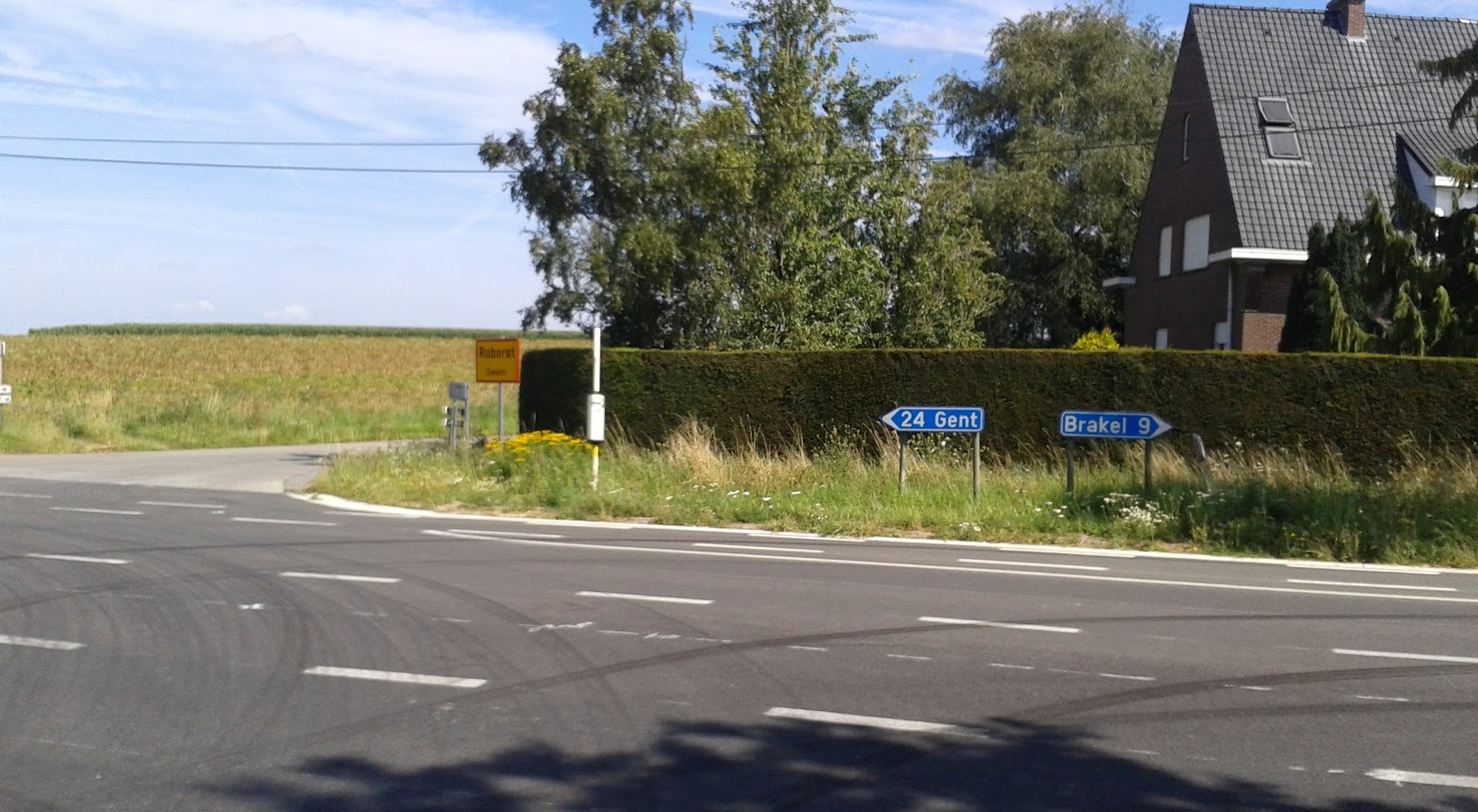
The other day when I was taking a stab in the dark and riding off in a new direction I came across a sign on the side of the road that piqued my interest:

So I followed it for a while and before long found myself riding along some beautiful country lanes away from the busy roads, with my friends the ubiquitous wheat and corn fields.


At each sign I noticed it still said 114km, so either I was on a giant treadmill not moving anywhere, or this was a loop. Of course it was a loop - a tour of Flanders. I didn't have time to investigate the whole thing that day but decided it would be a good one to come back to and check out in its entirety some time soon. That day ended up being Wednesday this week, with clear skies and everybody off work for the national holiday of l'assomption. I expected it to take maybe 4 - 5 hours, including getting to and from the loop from where I'm staying in Enghien, some 15km away. People go on about how flat the land is in Flanders, so I thought this seemed reasonable. What I missed from what people go on about is that this loop in primarily just in the Flemish Ardennes, which is riddled with hills and bumps of all shapes and sizes. So, 114 very up and down kilometres as I was to find out.


I joined the tour route at Geraardsbergen, most famous in cycling for its cobbled climb up the Muur van Geraardsbergen, or "Kapelmuur" because it leads to a chapel at the top. It's the scene of many famous attacks, such as Cancellara in 2010. Listen to the crowd!


There are a few cafés/bars on the way up, all of which were packed to the gunnels with people enjoying a crisp Belgian in the sun. I chose instead to carry on towards the next feature of the parcours, another pavé climb called the Bosberg.


This one isn't as steep, but the surface is a bit rougher because the stones have loosened over time and become more spaced apart. Getting towards Kinderkoppen status ("children's heads" as the cobbles are known colloquially) but worse was to come. It's quite a nice ride through the trees at a moderate pace, but I can imagine it being quite another thing after already 250-odd kms at a hectic pro race pace.

Not long after this I caught up with an older gentleman cruising along on quite a flash road bike, in nothing but Sidi's and bib shorts with the straps off his shoulders dangling around his waist. His skin was like leather, tanned so as to be I imagined tougher than that of his saddle. He spoke a little French so we chatted briefly, and it turned out he'd already been for a ride that morning out to Bruges. I asked him about the route I was following, and he said that it ended about 3 or 4km up the road. I was a bit confused by this, as I didn't think a loop could really end, as such. How long is a piece of string? How about if you lay it out on asphalt? Well it turns out that the route just turns in on itself briefly, before heading back in a generally Westerly direction that goes north of Geraardsbergen.

The day was heating up and I had with me one bottle of water and three muesli bars. Just to be on the safe side I had some money too, but I probably overestimated the power of my budget as €5 doesn't go all that far. I stopped off at a Frituur for a can of Coke, and realised once I'd stepped in the door that I still hardly know any Dutch. The two guys working there looked to be training buddies with Arnold Schwarzenegger, but both greeted me cheerily. I suddenly felt embarrassed and, not wanting to greet them immediately in French, nor presuming to just speak English straight away, I hesitated tongue-tied until the gears started turning in my brain and I remembered hello. Suitably delayed so as to be quite awkward and almost out of context. I quickly got my can out of the fridge and paid the man, slinking back out the door with a sheepish nod of thanks and a mumbled "dank u".

My communication problems couldn't possibly get any worse than this I decided, and so rather than shy away from these occasions I promised to make more of an effort and approach people more readily, with less concern for the accuracy of my utterances. Any greeting is better than silence. I really don't like the feeling of not being able to express myself (I don't imagine anyone does) but especially when I'm generally able to in French, and just down the road it's back to square one again for me in Dutch.

So after a nice cruise down a tree-lined boulevarde I was trying to decipher which direction to interpret the sign as indicating, when a couple came to align their map with the same sign. They were from Gent but as I found out after somehow explaining my lack of Dutch in my non-existant Dutch, they spoke some French. It seems most Flemish people do at least speak a little, but whether they're happy to use it is another question. At least that's what all the French speakers I have met have to say about the Flemish, but so far I've found them to be quite happy to speak French with me. I suppose it's that or nothing though. I keep my English a secret until it's absolutely necessary, then pull out the trump card - I'm a New Zealander. They love it.

As the green route leads me deeper and deeper into the Flemish countryside, I start to notice a few things. The roads seem generally to be in better condition in this part of the country (I read that Hainaut, where I'm staying and the province just south of East-Flanders, is the lowest socio-economically) as is the state of the properties bordering the road. The gardens are so pristinely kept, the brick façades of houses immaculate. Finally the consideration given to cyclists by way of cycle paths and lanes at all times is quite significant.


I'm fairly well disorientated by this point, and hoping that as long as I follow the hexagonal signs placed at every intersection I'll make it out alive, before dark. But sometimes there's an intersection without a sign, or an arrow pointing straight ahead towards a road that splits, veering off in multiple directions. This became quite a common theme for the ride, and at one point caused me to have to double back after a kilometre or more of some pretty juicy "koppen"

As time passes, so washes away the mortar or whatever is used to secure the stones, until all that is left is sand and debris between them. This has a tendancy to make it quite a "rock 'n' roll" ride sensation. With eyes rattling around in your skull desperately seeking the smoothest line to take, trying to avoid the ruts and holes caused by cars and erosion, and every ounce of flesh on your body quivering like you're riding a compactor, it's quite an experience. Quite an unpleasant experience, it turns out, especially after a few hundred metres. I really gained an appreciation for the guys who race Paris-Roubaix and the like, doing it over and over for six or more hours.

Eventually I broke out onto some of the smoothest tarmac I've ever encountered, and a view of the countryside just out of Oudenaarde.

Semi-effective panorama
This is a beautiful town, once again immaculate and unified in its elegant aesthetic. I made my way into the centre, partly by accident, but the signs had stopped and so I wanted to see if I could find some information about where to go. I needn't have worried, as low and behold I stumbled upon the Museum of the Tour of Flanders, of course.

I wasn't really expecting this, so of course I briefly ventured inside to have a peek and hoping to find a vending machine to get another drink. I would have loved to visit the museum but I wasn't really in the best state of attire or comfort for that kind of thing. I got a coke and a fanta, and refilled my water bottle in the toilets. Where I spotted this humorous wee number, so to speak.

Out the front they have a nice display set up:


I found a map of the green route I had been following, along with a red and a blue route, which both take in different parts of the area. The red being more hilly, the blue being more cobbly.
I'd been riding for about 4 or 5 hours by now, and was looking forward to heading back in the general direction of home, as that is where the green route should logically take me. But of course it wends its way up and down and around much more than I was expecting, and so took significantly longer than it appeared it would.

At one point on the way back I stopped at a small tavern to ask for directions and for some water for my bidon. There were two cool old guys sitting out the front smoking and drinking, and both were keen to help. We had a hilarious conversation with bits of French, English and Dutch all mixed together trying to understand each other, with the net result being that they knew the route of the race and that it passed right by and up the hill in front of me.

I went up the hill and sure enough, there was the green hexagonal sign I had been hoping for. Dank u gentlemen.

Due to the combination of my fatigue and therefore inattention, the occasional moss covered or otherwise misplaced sign leading me back and forth it wasn't for another 3 hours that I finally made it back home, exhausted but satisfied that I had got through it. That is to say, I had got through half of it. I realised, sitting down having a cool drink at home, the red and blue routes are still waiting for me to explore them - I had only covered half of the race, a small amount of the cobbles, and not the steepest of the climbs. As they say over here, chapeau to the riders.